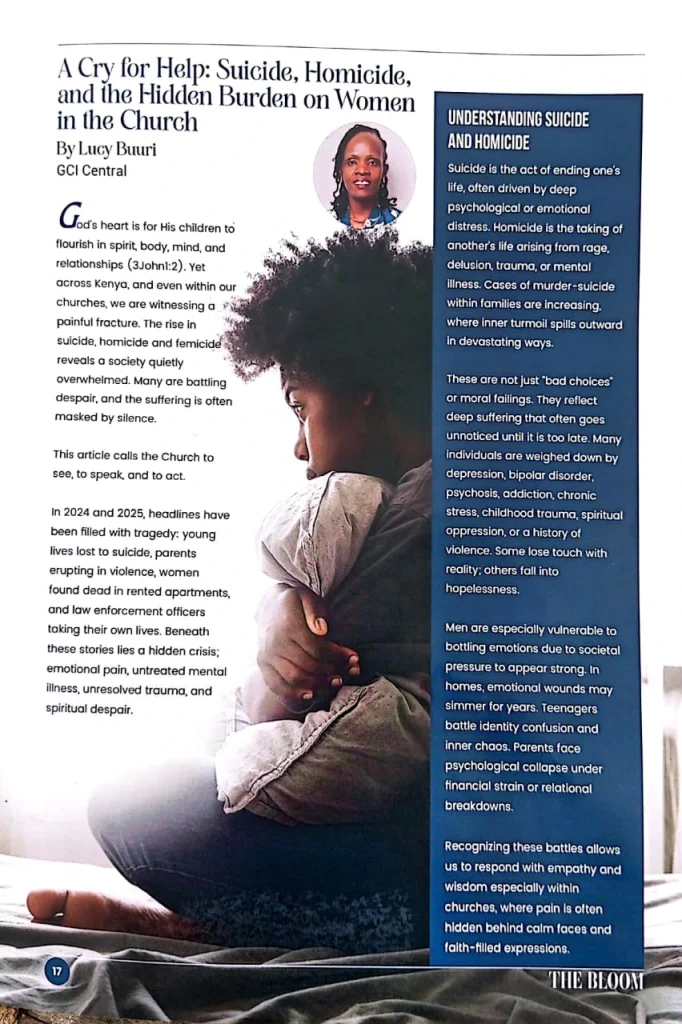
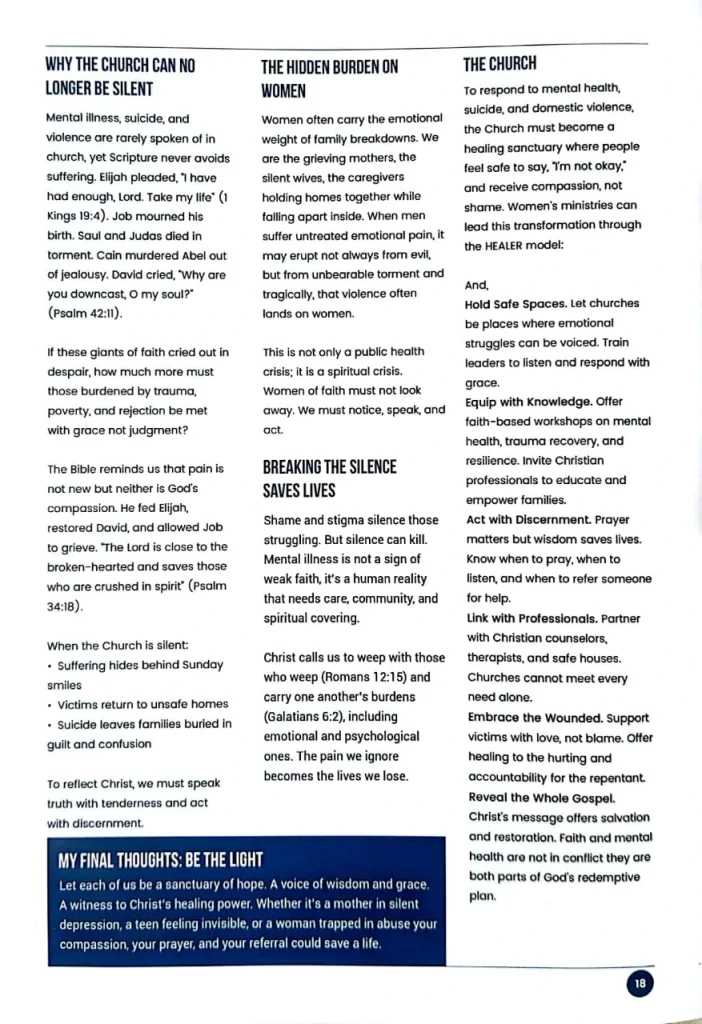
A Cry for Help: Suicide, Homicide, and the Hidden Burden on Women in the Church

christian-life-crisis-prayer-god

I am honoured to have contributed to the Bloom Magazine (August 2025 Edition), produced by Gospel Blooms International, a women’s ministry under Gospel Centres International.

My article, titled “A Cry for Help: Suicide, Homicide, and the Hidden Burden on Women in the Church”, addresses some of the most urgent and often silenced struggles in our communities. Behind every statistic are real families, grieving mothers, and silent cries from our pews in the churches across the Nation.

This piece is both a call to awareness and an invitation for the Church to become what Christ intended – a healing, safe community for the broken-hearted.

My prayer is that this article will spark courageous conversations in churches, fellowships, and homes. May we learn to break the silence, stand with the hurting, and bring Christ’s healing presence where despair has taken root.
havenofwellnesscenter
haven of wellness magazine

Let’s Walk This Journey Together

How I Can Partner with Your Church

At Haven of Wellness Centre, we believe the church can be a true HEALER community. Here’s how we can partner with your ministry:

  1. Training your ministers in basic counseling skills and principles.
  2. Establishing healing groups for emotional and spiritual support.
  3. Workshops and training on mental health, wellness, parenting, and teen mentorship.
Support for Individuals and Families

At Haven of Wellness Centre, we provide professional counseling, therapy, positivity coaching and parenting Support in Kenya. Our commitment is to create a safe, non-judgmental, compassionate, and confidential space where individuals, couples, parents, and families can heal, grow, and thrive.

If you are struggling in silence- whether with depression, anxiety, trauma, parenting challenges, or relationship pain-because of shame, stigma, or fear, we encourage you to take a step toward help. We understand that earthen vessels can break, but we also believe healing and restoration are possible. You don’t have to walk this journey alone.

We also provide Christian counseling and faith-based perspectives for those who desire spiritual integration alongside professional therapy.

Our Commitment

Whether you are an individual, a parent, a couple, or a family, Haven of Wellness Centre is here for you. We accept You, honor,  and respect your story. Together, let’s build healthier families, stronger communities, and a church that is truly a sanctuary of hope.

If you’d like to invite me to support your ministry or if you personally need help—you can reach me at:

+254732365320 (Call/WhatsApp) or Email:lucybuuri@havenofwellnesscentre.com

Empowering Teens with Life Skills and Personal Leadership: A Modern Parenting Essential

group-students-spending-time-together-haven of wellness center

In today’s fast-paced, always-connected world, one of the greatest gifts you can offer your teen is the ability to lead themselves well. With mounting pressures from academics, social media, friendships, and identity, many teens feel overwhelmed and uncertain about how to navigate life with confidence and clarity.

As a parent, you may feel torn between wanting to protect your child while knowing it’s time to let them grow. That’s where personal leadership and essential life skills come in. These tools empower teens to take ownership of their decisions, emotions, and growth even amid a world full of distractions.

Why Life Skills and Personal Leadership Are Non-Negotiable for Today’s Teens

Let’s face it: growing up today isn’t what it used to be. Teens now face:

  • Constant pressure to succeed academically
  • Peer and online comparisons that chip away at self-esteem
  • Confusion around identity and belonging
  • High levels of stress and anxiety
  • Temptations to conform instead of thinking critically

These are real, daily struggles. While love and support from parents remain crucial, teens also need the tools to lead themselves with wisdom and confidence.

For teens to master self-leadership, parents must be conscious and intentional in tuning in to their teen’s heart needs at every stage. Gradually equipping them, allowing more decision-making responsibility, and guiding them through the outcomes of their choices fosters maturity and resilience.

happy-black-people-having-fun-together-haven of wellness center

 Why Parents Must Gradually Release Control to Empower Growth

It’s natural to want to guide every step your teen takes. But holding on too tightly can backfire. Teens flourish when we shift from control to coaching and from constant correction to intentional connection.

Personal leadership allows you to gradually hand over responsibility under your guidance. When teens learn to lead themselves, they:

  • Develop emotional regulation and resilience
  • Strengthen critical thinking and make value-based decisions
  • Build confidence and self-discipline
  • Take initiative in school, chores, and personal goals
  • Manage digital influences and social relationships wisely

This shift empowers teens and eases the parenting burden.

Vital Life Skills Every Teen Needs to Thrive

To confidently face life’s challenges, teens need a strong foundation. Key skills include:

  • Self-awareness and healthy self-esteem
  • Emotional intelligence and stress resilience
  • Goal-setting and personal accountability
  • Effective communication and boundary-setting
  • Digital literacy and social media discernment
  • Healthy habits and holistic self-care

When teens master these areas, they don’t just cope they thrive.

The Teens Thrive Program: Build the Life You Were Meant to Live

At Haven of Wellness Centre, we created the Teens Thrive Program to help teens aged 13–18 grow into confident, resilient, and self-led individuals.

Delivered through live, interactive Zoom sessions, this online coaching experience offers:

  • A safe space to explore identity and purpose
  • Practical tools to manage emotions and stress
  • Coaching to build strong communication and healthy relationships
  • Guidance in setting goals and staying motivated
  • Encouragement to take ownership of choices and the future

Each class draws from our T.H.R.I.V.E. model, equipping teens with skills to lead themselves, build healthy relationships, connect meaningfully, and stay anchored through life’s ups and downs, helping them thrive in life while making the parenting experience lighter and enjoyable.

How to Help Children and Teenagers Navigate Grief

How to Help Children and Teenagers Navigate Grief - Haven of Wellness Center

Children and Teenagers grief too! A gentle guide for parents, teachers and care givers

In the wake of the recent traumatic events following the June 25th and Saba Saba protests in Kenya, many young people are silently carrying the weight of grief. Some have lost loved ones. Others have witnessed distressing scenes unfold in their communities or on screens.

As a counselling psychologist, I have observed that each new tragedy often awakens postponed grief-old wounds that were never fully acknowledged. This guide invites all adults to recognize the complex layers of loss children and teens face and to walk with them toward healing

Understanding Grief and Mourning in Young Hearts

Grief is the inner world of emotions after a loss: deep sadness, confusion, anger, guilt or fear. Mourning is the outward expression of those feelings, shaped by culture, family traditions and personal beliefs.

Children and adolescents grieve deeply, but often in ways that can be hard to recognize. Their sorrow may surface as repeated questions, changes in play or schoolwork, sudden tears or withdrawn behaviour.

Loving Mother Embracing Sad Offended Little Son, Giving Support to Child - Haven of Wellness Center

How Sudden or Traumatic Loss Affects Children and Teens

  1. Shock and Confusion
    Young people may seem numb or as if nothing has happened.
  2. Anxiety and Fear
    They may worry about their own safety or cling more tightly to caregivers.
  3. Anger or Guilt
    Feelings of blame—toward themselves or others—can arise.
  4. Withdrawal and Sadness
    Interest in school, friends or favourite activities can fade.
  5. Trauma Responses
    Nightmares, intrusive memories or physical complaints such as headaches or stomach aches may appear.

These reactions are not signs of weakness. They are a young mind’s attempt to process something deeply painful.

            Myth

Truth

Children are too young to understand death

Even toddlers sense loss. They feel it before they fully understand it.

No tears means no grief

Sorrow often shows up as behavior changes, withdrawal or physical symptoms.

Talking makes it worse

Honest, age-appropriate conversations help children feel safe and reduce confusion.

Teens should cope on their own

Adolescents still need emotional support, validation and safe spaces to express pain.

Time alone will heal

Grief evolves over time. Unacknowledged sorrow can resurface at later stages of life.

Understanding Grief and Mourning in Young Hearts- Haven of Wellness Center

Warning Signs That Professional Help Is Needed

Watch for any of these persisting beyond a few weeks:

  1. Bedwetting, clinginess, sleep or eating disturbances
  2. Intense fear of being alone or constant worrying
  3. Withdrawal from friends, family or activities
  4. Obsession with death or repeated morbid questions
  5. Risk-taking behaviour or talk of self-harm
  6. Prolonged mood swings, irritability or aggression
  7. Frequent headaches, stomach aches or other physical complaints
  8. Sudden drop in school performance or refusal to attend
  9. No signs of improvement or worsening symptoms

If you notice any of these, especially signs of self-harm reach out immediately to a school counsellor or mental health professional.

Practical, Compassionate Support Strategies

Do

  1. Speak honestly, using words they can understand.
  2. Offer art, play or writing as outlets for emotion.
  3. Invite participation in remembrance rituals when they wish.
  4. Keep daily routines steady to rebuild a sense of safety.
  5. Encourage their questions, even if they repeat them.
  6. Model healthy mourning by sharing your own gentle honesty.

Do Not

  1. Rely on confusing euphemisms such as “gone to sleep.”
  2. Rush them to “be strong” or “move on.”
  3. Dismiss changes in their mood, behaviour or schoolwork.
  4. Shame tears, anger or fear.

What Children and Teens Often Ask and What They Need

Question

What They Need

What happened?

A clear, honest explanation.

Will they come back?

Gentle clarity on the finality of death.

Was it my fault?

Reassurance they bear no blame.

Is it okay to cry or be angry?

Validation that all emotions are normal.

Who will take care of me now?

Assurance of love, support and stability.

How can I remember them?

Permission to share stories, drawings or keepsakes.

Will I ever feel happy again?

Hope that healing and joy will return over time.

The Power of Community in Healing

Grief becomes lighter when shared. Schools, churches and neighborhood groups can offer memorial gatherings, storytelling sessions and support circles. These communal spaces remind children and teens they are not alone in their sorrow—and that healing is possible together.

Guidance for Schools and Teachers

  1. Provide a quiet room or support corner for grieving students.
  2. Allow flexible attendance, deadlines and participation.
  3. With family consent, inform classmates to reduce rumors and isolation.
  4. Train staff to recognize and respond to signs of grief and trauma.
  5. Partner with counselors and mental health professionals for referrals.

Final Thoughts: Be Present. Be Gentle. Be Consistent.

Children may not grieve in obvious ways. Their pain can look like anger, withdrawal, or even silence. Sometimes, it surfaces long after the loss.

What they need most is your steady presence.

Show up. Be patient. Offer quiet reassurance.

Grief isn’t something to fix—it’s something to hold. Your calm, consistent care can become their anchor through the storm.

Support from Haven of Wellness Centre

At Haven of Wellness Centre, we understand that grief can be layered—both fresh and buried. We offer a safe, compassionate, and non-judgmental space where children, teens, and families can process loss and begin healing. Whether you’re a parent, caregiver, teacher, or guardian, we’re here to walk with you.

The Surprising Truth About What Makes Teens Cooperate

Teen Behaviour Decoded - Haven of Wellness Centre

What Really Makes Teens Cooperate? The Truth May Surprise You

Have you ever wondered why your teen resists even the simplest instructions? Or why calm conversations can suddenly spiral into conflict, while that same teen can be light hearted and open with others they feel comfortable with?

Here’s the truth: Teens don’t cooperate just because we’re their parents. They cooperate when they feel emotionally connected to us.

Parenting Teens Is a Delicate Balancing Act

Parenting a teen often feels like walking a tightrope. On one side, they crave independence. On the other hand, they still need structure, support, and connection.

Many parents struggle to influence their teens without causing pushback or emotional distance.

The surprising key to getting your teen to listen and cooperate? It’s not pressure. It’s not control.

It’s connection.

Why Connection Builds Willingness and Cooperation

Teens are emotional and intuitive. When they feel safe, seen, and respected, they don’t just comply — they engage.

Cooperation doesn’t come from control. It flows from trust.

 What Real Teens Are Saying

In my work as a counselling psychologist, I’ve heard countless teens share how deeply their parents’ connection influences their choices:

  • “I could have dropped out, but I didn’t want to disappoint my parents.”
  • “I had chances to use drugs, but I thought about how much my parents believe in me.”
  • “I wanted to end my life… but I couldn’t bear the thought of the pain it would cause my parents.”

These reflections highlight a powerful truth: When a teen feels anchored to a caring adult, that connection becomes a compass. It helps guide them, even through tough moments.

Strong Parent-Teen Relationships Lead To:

  • Better decision-making
  • Lower risk-taking behaviour
  • Increased cooperation at home
  • Long-term emotional stability

Warmth + Guidance = Trust + Cooperation

Influence Comes from Relationship, Not Control

Here’s one of the most overlooked truths in parenting: You can only guide a teen who is willing to be guided.

That willingness is earned, not demanded. And it grows through emotional connection, not constant correction.

If you’ve ever thought:

  • “I’m doing everything right, but my teen pushes me away.”
  • “They hear me, but they don’t listen.”
  • “I feel like I’m losing control.”

You’re not alone.

The good news? Influence can be rebuilt when we shift how we relate to our teens.

Teen Behaviour Decoded - Haven of Wellness Centre

Photo by Fizkes via Canva

Connection Is Not the Same as Permissiveness

Let’s be clear: connection doesn’t mean letting teens run the show. They still need:

  • Boundaries set with calm authority
  • Clear expectations explained with empathy
  • Respectful, consistent consequences

What changes is how we deliver those things.

When structure is paired with warmth, teens feel safe — and they respond better.

What Happens When Connection Breaks

When teens feel disconnected, they are more likely to:

  • Resist rules
  • Withdraw emotionally
  • Make impulsive or risky decisions
  • Struggle with low self-worth

But there is hope: Even strained relationships can be repaired with intention and consistent effort.


Want More Cooperation at Home? Start Here.

You don’t need a total overhaul. Often, one small shift creates a ripple of change.

Try starting with:

  •  Listening without interrupting
  •  Validating emotions before correcting behaviour
  • Showing love even when setting limits
  •  Speaking to your teen with the same respect you want in return

Let’s Rebuild the Connection — Together

If you’re feeling overwhelmed, shut out, or unsure of what to do next, you don’t have to go through it alone.

I offer private counselling and parenting support to help you:

  • Understand your teen’s emotional world
  • Repair broken communication
  • Guide with calm, confident authority
  • Rebuild trust and healthy cooperation

You can raise a teen who listens, cooperates, and thrives — not out of fear, but out of relationship.

Let’s take the first healing step together.